This article has been revised to reflect the following correction:
Correction: September 12, 2013
A picture caption with an earlier version of this article referred incorrectly to Voyager 1. It is a spacecraft, not a satellite.
This article has been revised to reflect the following correction:
Correction: September 12, 2013
A picture caption with an earlier version of this article referred incorrectly to Voyager 1. It is a spacecraft, not a satellite.
For years, scientists have been anticipating the spacecraft Voyager 1's exit from the solar system. So far, it's been difficult to tell. But this week scientists announced that, at long last, they have proof that Voyager has punched through to interstellar space. Voyager chief scientist Ed Stone joins to talk about the mission's final frontier.
Copyright © 2013 NPR. For personal, noncommercial use only. See Terms of Use. For other uses, prior permission required.IRA FLATOW, HOST:
This is SCIENCE FRIDAY. I'm Ira Flatow. It's one of the most enduring questions in modern space exploration, a puzzle scientists have been trying to solve for years. Are we there yet? Where is the Voyager 1 spacecraft? Where is it right now in relationship to where we are?
(SOUNDBITE OF ARCHIVED SHOW)
FLATOW: Well, it's 11 billion miles out...
UNIDENTIFIED WOMAN #1: Voyager 1 will be leaving the region called the Helio...
FLATOW: Tell us where it is? How do you know that it's at the edge of our solar...
UNIDENTIFIED WOMAN #2: How close is it to leaving our solar system?
UNIDENTIFIED MAN: We don't know exactly but...
FLATOW: It's reached the edge of the solar system, or has it?
Now, that last clip was from this show ten years ago, so we have been talking about this for a long time. And today, we can put an end to all that back and forth. This week scientists announced they've found conclusive evidence that Voyager 1 has finally punched through the heliosphere, the sun's bubble around the planets and it's now traveling through interstellar space, a place where no manmade spacecraft has gone before.
They published the results this week in the journal Science, and here to talk about it is the grandfather of the Voyager program, Ed Stone, chief scientist for Voyager, professor of physics at Cal Tech in Pasadena. Welcome back to Science Friday, Ed.
ED STONE: I'm glad to be with you, Ira.
FLATOW: Well, should I ask that question that I've asked every time? Where is it, Ed?
(LAUGHTER)
STONE: Well, it's now in the space between the stars, the interstellar space. It's really on a new journey.
FLATOW: Has it left the solar system?
STONE: Well, not really, you see because the Oort cloud of comets is also in the same interstellar space as Voyager is now, so that part of the solar system is actually in interstellar space.
FLATOW: But the textbook definition where, you know, that we all grew up with, the nine planets, now eight, that was always talked about the solar system, so it's past the planets then?
STONE: Oh it's well past the planets. That's right. The outermost planet is Neptune, which is 30 times as far from the sun as the earth and Voyager is now, when it entered interstellar space it was 122 times as far from the sun as the Earth, so you can see we are well outside of all the planets.
FLATOW: Did you ever think it would get this far?
STONE: Well, we hoped. We didn't know, of course. When Voyager was launched in 1977, the space age was 20 years old, so we had no way of knowing whether spacecraft could last this long or not, but they really have done a - these are the longest-lasting spacecraft ever launched and of course they are by far the farthest traveling ever launched.
FLATOW: And when you say they, you're talking about its sister ship, Voyager 1, Voyager 2.
STONE: Yes, that's right. There are two of them and Voyager 2 is about 16 days longer in space then Voyager 1 because it was launched first.
FLATOW: And what was its mission when it was first launched?
STONE: The mission we had was very carefully defined to be a four-year mission to Saturn. And everything else after that was a bonus. We launched in 1977 because that was the magic year when a single spacecraft could actually fly by all four giant outer planets. We did it step-wise. First to Saturn and then we added Uranus, and then we added Neptune and then we added the interstellar mission, which has been going now since 1990.
FLATOW: And how have you been able to get it past Saturn, which was your original destination, to get way out there?
STONE: Well, we used the slingshot effect to propel the spacecraft. There was no problem in the sense of knowing how to get there. It's whether or not the spacecraft would actually survive and continue to function for that. Nobody knew that these spacecraft - there was no experience that the spacecraft could work so well for so long, and such great distances from the sun. The communication, if course, is 10,000 times more difficult out there than it is if you're near, only 1 AU away from earth.
FLATOW: What's the size of the transmitter power?
STONE: It's a 22-watt transmitter, but it's focused in generally toward the planets and the signal strength itself when it gets to Earth on the deep space network is something like a tenth of a billionth of a billionth of a watt.
FLATOW: And it has one of these old tape systems on it?
STONE: It has an eight-track digital tape recorder, so it's - that's how we recorded the images during our planetary encounters and now we record the wideband data from the plasma wave system, which is the system which, in fact, gave us the final information we needed that we were in the dense plasma of interstellar space rather than in the more rarified plasma, solar plasma that's inside this bubble.
FLATOW: Now you had some idea, you knew, the planners knew that this would be going out into the solar system because there's a famous golden record on it, right? Sounds from the Earth on it.
STONE: Yes, yes, that's right. We knew that these were going to escape the sun and go into their own independent orbits in the Milky Way galaxy, orbiting the center of our galaxy along with all the stars.
FLATOW: And was that Carl Sagan's idea to put that on there?
STONE: I mean, what is on the record was a team he put together decided that it was a record, what to put on it, but the idea of having such a message was one which was patterned after what had been done on the Pioneer 10 and 11 spacecraft. And Jean Cassini who was the project manager for what was then called Mariner Jupiter Saturn '77 asked Carl Sagan if they would think of a similar message for Voyager and they came up with a much better message where there is an actual record, 16 2/3 two-sided long-playing record, grooved record, which has the sounds of Earth, greetings from Earth in many languages, music from Earth from many different cultures. And of course something over 100 images of Earth, the place that sent these ambassadors to the Milky Way.
FLATOW: Ed, tick off for us some of the major accomplishments from the Voyager.
STONE: Well, in the biggest sense, the most important planetary result was that we really completely changed our view of the solar system. It revealed how diverse the bodies are in the solar system. Each one is unique and that's because of geologic history affected each of them separately. But it's even more than that. There's so many things that we thought we knew that we didn't. Before Voyager, the only known active volcanoes in the solar system were on Earth.
And then we flew by Io, a moon of Jupiter, a small moon, and it had eight active volcanoes and, it turns out, ten times the volcanic activity of the earth. And so that was just the first step of sort of greatly expanding our view of bodies and their evolution and their properties, which prior to that was really based on our limited experience with Earth.
FLATOW: Yeah. And you discovered all kinds of properties about Jupiter and the other planets.
STONE: That's right. And Saturn of course we found its moon Titan had another nitrogen atmosphere just like Earth but even denser than the Earth's atmosphere, but no oxygen. Instead of that it has methane, natural gas which rains on the surface, so that, again, really sort of broadened in a great way, broadened our view of bodies in the solar system.
And I always like to talk about the last body we visited, which is Neptune's moon Titan. It's the coldest body we've visited, only 40 degrees above absolute zero. So cold the nitrogen is in ice form in its polar region yet we found geysers erupting at 40 degrees above absolute zero. And before Voyager, the only known geysers were here on Earth.
So time after time, our view had to be so greatly expanded. And I think that was the biggest, broadest impact of that part of the Voyager mission. Now we're on a totally different mission, which is the first to leave the solar bubble and begin to sail on the cosmic sea that's between the stars, 'cause that's what most of the Milky Way is, is the sea between the stars. They're not the stars but the sea between.
FLATOW: And can it still do a useful work while it's that old, that far and that weak?
STONE: Oh, we certainly can. We can measure - if we have some more help from the sun in getting some more resonances in the plasma, we can measure how the density of the plasma is actually growing as we move further away from the heliosphere. We can measure the interstellar magnetic field, which is the galactic magnetic field which has been captured and carried by the interstellar wind.
The interstellar wind itself is the result of the explosion of supernova, massive stars, five, 10, 15 million years ago, so we'll be able to understand and see how variable that is on a - at least on a decadal time scale which is sort of the time scale in which we still expect to be able to operate voyager.
FLATOW: And how much longer can it operate out there in space?
STONE: Well, you know, we have this wonderful power supply which is basically the natural radioactive decay of Plutonium 238, which generates heat. Lots of thermal couples convert that heat to electricity, and the nice thing about Plutonium 238 is the half-life - that is, that's how much it decays to half its current value (unintelligible) so we can predict fairly well that our power will have decayed to the point by 2020 that we'll have to turn off one of our science instruments.
And then as it continues to decay, we'll have to turn off the second and the third, and finally in 2025 we'll have to turn off the last science instrument. But at that point we will be almost 170 astronomical units from the Earth. Today we're at a 125.
FLATOW: Is there, in your experience, and you - as I called you, the grandfather of this project, are there any other spacecraft like the Voyager ever been built?
STONE: No, no. No, these are unique spacecraft and I think they will remain so because really you do this sort of thing where you survey so much, so many new things, just once. The future spacecraft, as you know, have gone into orbit because the next phase of exploration is the detailed look you can get only when you're in orbit, so Galileo went back to Jupiter and went into orbit, and Cassini is now in orbit around Saturn today.
The only other spacecraft that's escaping - that will escape the solar system is the Pluto flyby New Horizons, and it's not traveling as fast as Voyager, so it will never catch up with Voyager, and I don't really know how much power reserve they have so I don't know how much longer they can operate beyond the Pluto encounter in 2015.
FLATOW: So what are your thoughts, Ed, today, now that this is all happening?
STONE: Well, I think it's just remarkable, really. It's remarkable, but I think to put it in the larger context of exploration, this mission really is, it has commonality with the first circumnavigation of the Earth and with the first footprints on the moon. Now we have the first spacecraft actually measuring and observing in this realm which is filled with matter from other stars and our own sun.
FLATOW: Ed, congratulations to you and all of your staff and everybody who worked on this.
STONE: Thank you very much.
FLATOW: And we wish you many more years of observing and listening and learning for us.
STONE: You bet and I'll be happy to talk with you about it when we do.
FLATOW: I'm very happy to have you on as always. Ed Stone, chief scientist for Voyager, professor of physics at Cal Tech in Pasadena. Thanks again. We have to take a break. When we come back, a look at the pros and cons of desalination. Can it meet our water needs? Stay with us.
Copyright © 2013 NPR. All rights reserved. No quotes from the materials contained herein may be used in any media without attribution to NPR. This transcript is provided for personal, noncommercial use only, pursuant to our Terms of Use. Any other use requires NPR's prior permission. Visit our permissions page for further information.NPR transcripts are created on a rush deadline by a contractor for NPR, and accuracy and availability may vary. This text may not be in its final form and may be updated or revised in the future. Please be aware that the authoritative record of NPR's programming is the audio.This artist rendering provided by NASA shows Voyager 1 at the edge of the solar system.
APThe Voyager 1 spacecraft launched in 1977 on a mission to Jupiter and Saturn. It kept on going. Today it's billions of miles from Earth, and scientists have been predicting it will soon leave the solar system.
NPR has been on Voyager watch since at least 2003, when longtime science correspondent Richard Harris provided this warning of Voyager's impending departure.
But now Marc Swisdak, a physicist at the University of Maryland, says the spacecraft may have already left. "Late July 2012 is when we think it [left]," he says.
How did we miss that? As it turns out, it wasn't entirely our fault. Researchers thought the solar system was surrounded by a clearly marked magnetic field bubble.
This NASA diagram shows the two Voyager spacecraft inside the magnetic bubble around the sun. But Marc Swisdak believes it's already crossed the heliopause into interstellar space.
NASA"There's one at the Earth, there's one at Jupiter, Saturn — many planets have them. And so just by analogy we were expecting there to be something like that for the solar system," Swisdak says.
Scientists were waiting for Voyager to cross over the magnetic edge of our solar system and into the magnetic field of interstellar space. But in a paper in the September issue of Astrophysical Journal Letters, Swisdak and his colleagues say the magnetic fields may blend together. And so in July 2012, when Voyager crossed from the solar system into deep space, "Voyager just kept cruising along," Swisdak says. All scientists saw was a change in the field's direction.
But not everyone thinks Voyager has left. Ed Stone is NASA's chief scientist for Voyager. He thinks there is a magnetic edge to the solar system, and until Voyager sees a change in the magnetic field, it hasn't left the solar system. He's hoping that change will come in the next few years.
"I think that there is a very good chance before we run out of electrical power that we will be demonstrably in interstellar space," he says.
Until Voyager's power goes out or the magnetic field flips, the scientific debate will continue. So will Voyager's journey, Swisdak says: "Basically it's just happily heading out toward ... pretty much nowhere."

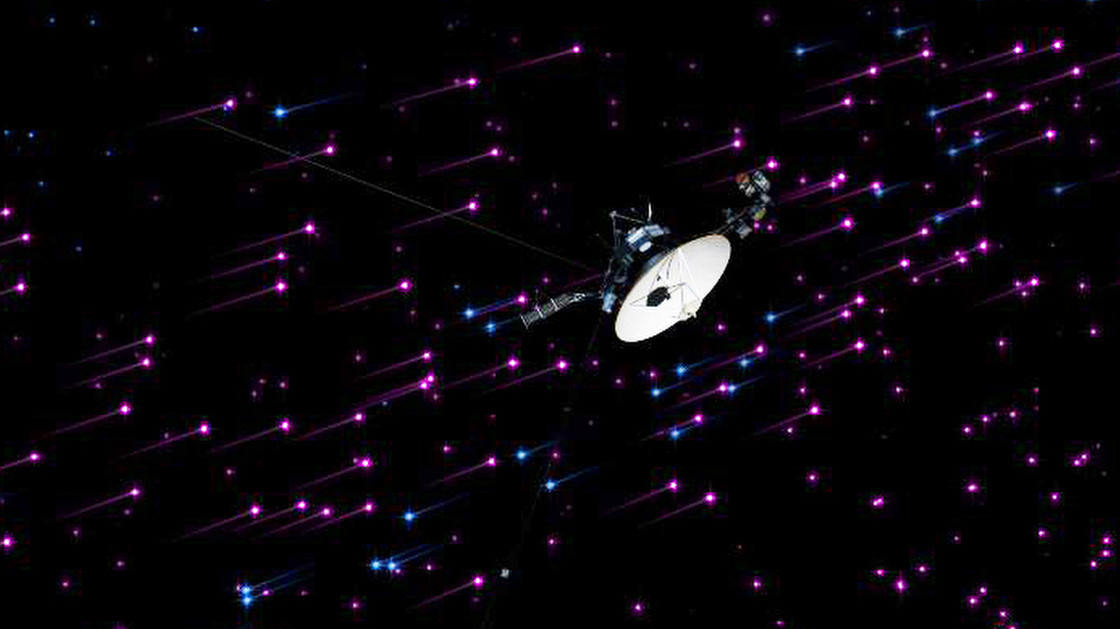 This artist rendering provided by NASA shows Voyager 1 at the edge of the solar system.AP
 This NASA diagram shows the two Voyager spacecraft inside the magnetic bubble around the sun. But Marc Swisdak believes it's already crossed the heliopause into interstellar space.NASA