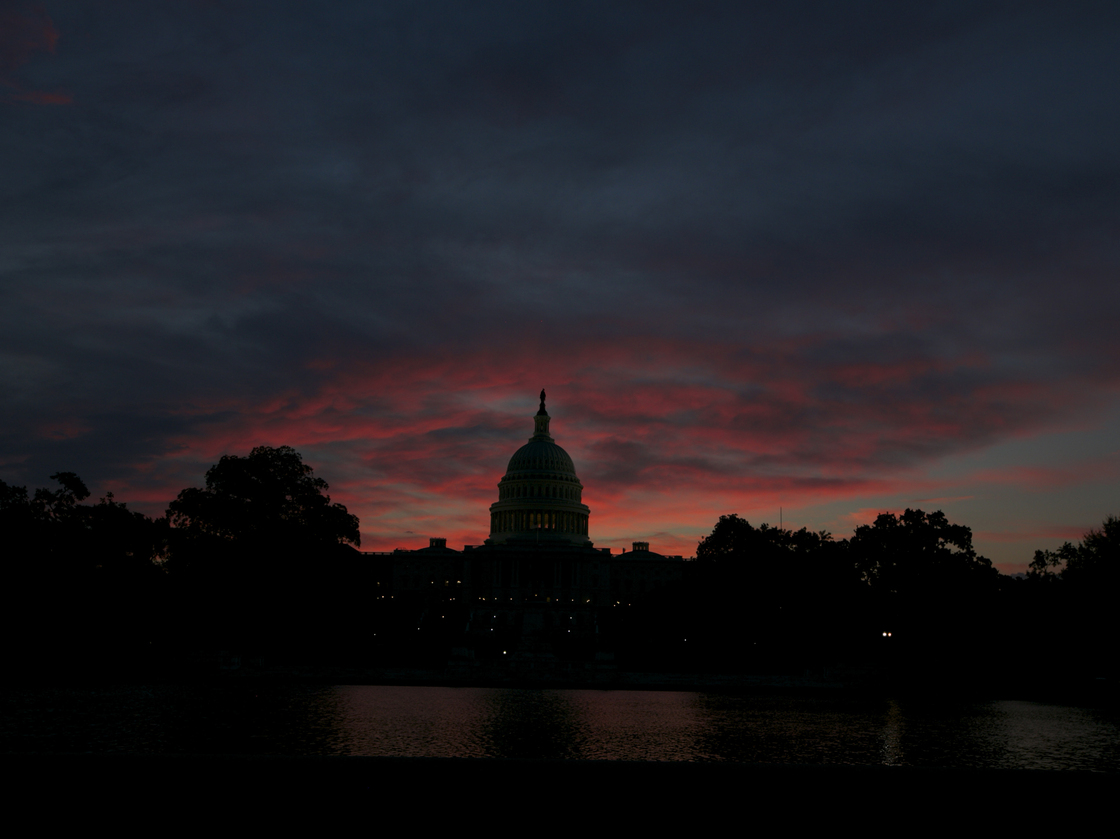
 The U.S. Capitol at sunrise.Jason Reed/Reuters/Landov
 No one who's been paying attention for, say, the past few decades, needs to be reminded of how extremely polarized Washington is.
So it's usually good news when Democrats and Republicans can come together on an issue, as they did recently to support the idea of creating the new honorary position of "Science Laureate of the United States."
We have had poet laureates, and they seem to have worked out well to promote poetry to the masses, haven't they? (Though I bet you can't name the current one. Me, either. Google says it's Natasha Trethewey.)
So why not a science laureate to sing the praises of scientific discovery, a science ambassador who could get more young people considering science careers?
Legislation was drafted, and it gained bipartisan sponsors. The proposal was seen as so self-evidently noncontroversial that House leadership planned to have members vote on it through the same expedited "suspension" process used for naming post offices.
If this were a movie, right about now you'd hear a loud skidding car sound, like someone had suddenly slammed the brakes. That someone would be Larry Hart, legislative director of the American Conservative Union, who happened to notice the science laureate bill on the House legislative calendar.
Hart, who back in the day was an aide on the House Science Committee, saw plenty wrong with the bill. He was troubled by how the bill "never saw the light of day" until 24 hours before it was scheduled to be speedily approved (although the bill was introduced four months ago).
And, he told me in an interview, "I found the bill to be very oddly written."
According to the bill's language, the laureate would be appointed by the president, unlike the poet laureate, who is appointed by the Librarian of Congress. The bill would also allow for the naming of as many as three laureates, whose terms could be constantly renewed, another difference from the poet laureate.
"What I couldn't understand," Hart told me, "was why [Republican] folks who constantly give speeches saying that they're upset with President Obama's appointments would give him the power for new appointments, particularly in the area of science, which he has a particular view of — in my opinion — a very politicized view of science. And his appointments in that area, on the regulatory side, have been very political."
Hart said that the administration's stance on global warming and climate science is part of what he sees as Obama's "very politicized view."
"I couldn't understand why the Republican House would take this bill up without any discussion," said Hart.
Neither could the House leadership after Hart made his objections known. The bill was pulled from the calendar and sent to committee for debate and revision.
ScienceMag.org's "Science Insider" blog quotes an unnamed aide for a House Republican co-sponsor of the bill, who says Hart is wrong in his suspicions that the bill would let Obama push a certain agenda.
But the House Republican leadership already has enough fights with its conservative base. You don't have to be a rocket scientist to understand that House GOP leaders are trying to keep one more issue from spinning out of control.


 September 18, 1968 is the day the Soviet space probe, Zond 5 became the first spacecraft to fly around the moon and return to Earth. It was designed to launch from Earth orbit, reach the moon and return as a precursor to a possible manned mission. Besides taking photographs of Earth and the Moon, the probe carried a biological payload of insects, bacteria, plants and two Russian steppe tortoises. The Zond 5 returned to Earth to splash down in the Indian Ocean. The probe was recovered and the tortoises survived. They lost some weight and the trip did not affect their appetite.
  Here is a fascinating and simple fire science magic trick for you. Make a seesaw candle! Basically, this involves piercing a candle with a needle, balancing the candle on a pair of glasses and lighting both ends of the candle. The candle will bob up and down of its own accord, like a fiery seesaw. I've got tips and tricks for you to ensure success, plus there is a scientific explanation for how the candle seesaw works.
 Listen to stories on failed stars, numerosity in the brain, monitoring a North Korean volcano, and more. (00:39:26)
  September 11th marks the passing of French astronomer Joseph-Nicolas Delisle. Among his accomplishments, he was the person who proposed the mechanism behind the sun dog phenomenon.
  On September 9, 1947, Grace Hopper discovered the first computer bug. She was working as an operator on the Harvard Mark II computer when the operators were attempting to trace a problem in the hardware. Wedged into Relay #70 on Panel F was a large moth's body and causing a short circuit. Hopper recorded and taped the find in the logbook as "The first actual case of bug being found".