The wild population of the golden lion tamarin, which lives only in Brazil's Atlantic Forest, fell to just 200 in the 1970s. Conservationists have helped the species rebound, but the monkeys are still at risk as development encroaches on their remaining habitat.
Andrea Hsu/NPR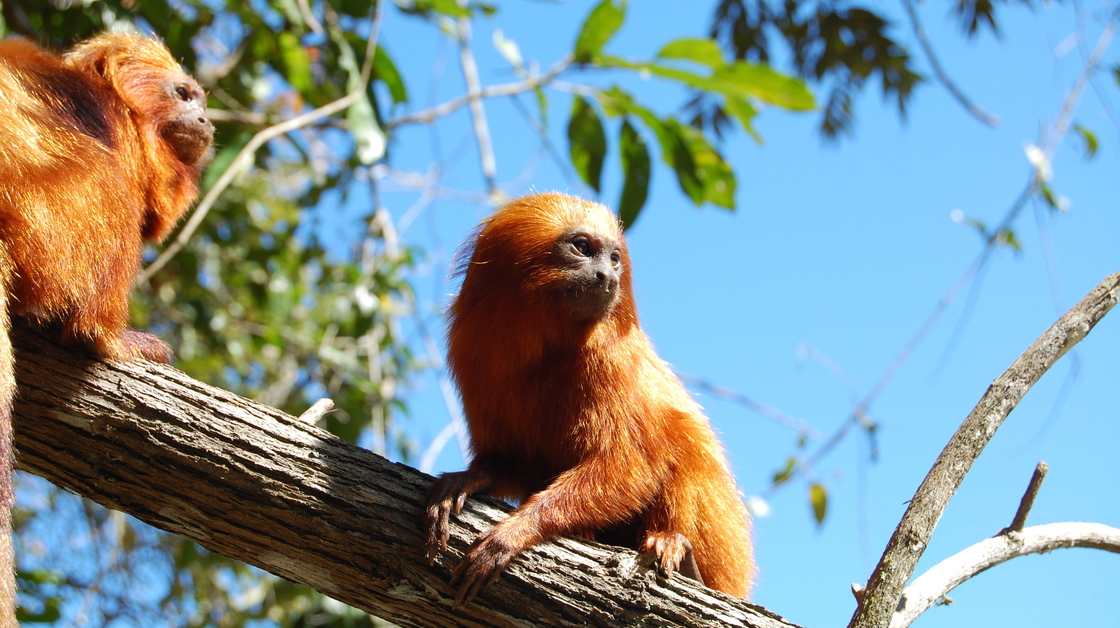 The wild population of the golden lion tamarin, which lives only in Brazil's Atlantic Forest, fell to just 200 in the 1970s. Conservationists have helped the species rebound, but the monkeys are still at risk as development encroaches on their remaining habitat.Andrea Hsu/NPR
 The tiny, copper-hued golden lion tamarin is so beloved in Brazil that its image graces the country's 20-real bank note. But this lion-maned monkey is in peril.
There's only one place on earth where the golden lion tamarin lives in the wild: in Brazil's Atlantic Forest, or Mata Atlantica, just north of Rio de Janeiro. Deforestation in the region has reduced the monkey's habitat, once a massive ecosystem stretching for a half-million square miles, to just 2 percent of its original size.
By the 1970s, the total golden lion tamarin population in the wild had plummeted to just 200 individuals. Conservationists have brought the monkey back from the brink — barely. Through captive breeding programs in zoos, the tamarin population grew until biologists were able to release tamarins into the wild.
At first, the zoo tamarins didn't know how to survive. Some were eaten by predators; some starved. But others managed to reproduce, and subsequent generations have thrived. Today, there are 1,700 of them living in patches of forest along the Atlantic Coast.
But that comeback may be short-lived. The monkeys need even more forest for their population to grow.
Power lines, roads and agricultural development in Rio de Janeiro state have isolated golden lion tamarins in forest fragments, leaving them vulnerable to inbreeding and other threats.
Mehgan Murphy/Courtesy of the Smithsonian Institution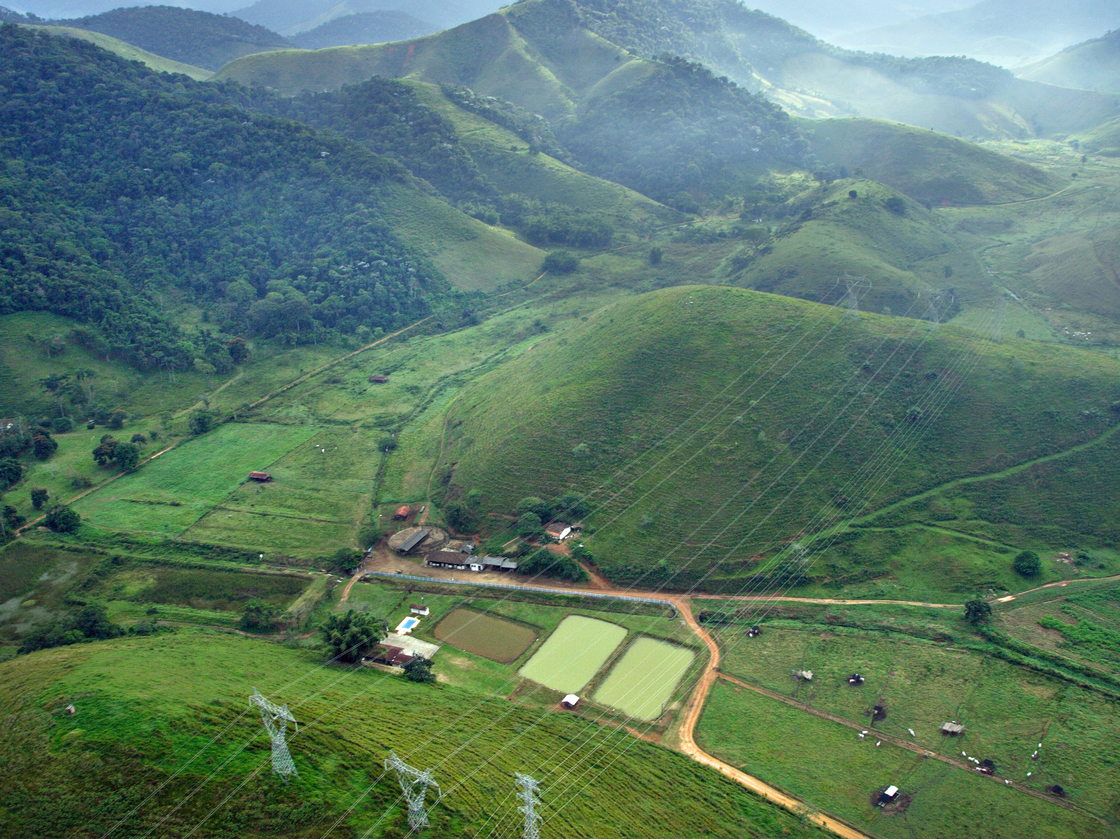 Power lines, roads and agricultural development in Rio de Janeiro state have isolated golden lion tamarins in forest fragments, leaving them vulnerable to inbreeding and other threats.Mehgan Murphy/Courtesy of the Smithsonian Institution
 Seventy percent of Brazil's human population lives in what was once the Atlantic Forest. Cities are ballooning and huge oil reserves have been discovered just north of here. A highway that cuts through this region is currently being doubled in size, from two lanes to four.
"We have very [little] forest left, and forest we have is absolutely fragmented," Luis Paulo Ferraz, head of the Associacao Mico-Leao Dourado, or Golden Lion Tamarin Association, tells NPR's Melissa Block. That fragmentation leaves the tamarin populations isolated in small forest patches, hurting the species' genetic diversity.
"That's why we have to create corridors" linking forested areas, Ferraz says. In the case of the highway, "the right thing to do is to create an artificial connection between both sides of the road. ... The tamarins need to cross over the road and need to have something that makes them feel protected."
Ferraz's group's idea is to create a sort of "tamarin bridge" stretching across the highway. It would require tree cover so the monkeys aren't exposed to bird predators, and it must be sturdy enough to withstand wind and the movement of trucks below.
Such a bridge has never been tried before, but the association, with support from its U.S.-based partner organization, Save The Golden Lion Tamarin, has been working on creating ground-level corridors for years, planting seedlings to connect the patches of forest habitat in a golden lion tamarin reserve.
A few miles away, a team from the group Agro Jardim, which works with the Golden Lion Tamarin Association on the reforestation effort, is planting trees that will eventually be home to a small group of tamarins.
Carlos Alvarenga, a forestry engineer, is in charge of the reforestation effort here. Does he ever feel mismatched, planting saplings while cities and roads grow around him?
"It takes a big effort," Alvarenga says. "But you can't just give up now. I'm certain that this work will succeed."

 A still from news video of Darwin's great escape in December.ABC News