With water security a growing concern around the world, the discovery of five aquifers in drought-plagued Turkana County could help secure Kenya’s access to the most critical of natural resources, particularly in the arid north. Out of a population of roughly 41 million people, 17 million Kenyans lack sufficient access to safe drinking water and 28 million are without adequate sanitation, said the United Nations Educational, Scientific and Cultural Organization, known as Unesco. “This newly found wealth of water opens a door to a more prosperous future for the people of Turkana and the nation as a whole,” Judi Wakhungu, Kenya’s secretary for the environment, water and natural resources, said in a Unesco statement on Wednesday. “We must now work to further explore these resources responsibly and safeguard them for future generations.” In addition to potentially providing drinking water, the vast underground supplies could be used as a source of irrigation for crops or to water livestock. Malnutrition has been a growing problem among the Turkana people, and a new supply of water could help head off conflicts over scarce resources in the region, where deadly cattle raids are common. The finds were a product of cooperation between the Kenyan government and Unesco, with the financial support of Japan. According to Unesco, further study is needed to determine exactly how much water there is and its quality. It also remains to be seen how easy and expensive tapping the new supply will be. The Lotikipi Basin Aquifer — which by one estimate is roughly the size of Rhode Island — and the smaller Lodwar Basin Aquifer were discovered using advanced satellite technology and confirmed with drilling. The other three aquifers still need to be confirmed through drilling, Unesco said. Gretchen Kalonji, Unesco’s assistant director general for natural sciences, said in the statement that the find “clearly demonstrates how science and technology can contribute to industrialization and economic growth, and to resolving real societal issues like access to water.” Radar Technologies International, the natural resources exploration firm that discovered the aquifers, said that they contained “a minimum reserve of 250 billion cubic meters of water,” or about 66 trillion gallons, and that rainfall in Kenya and Uganda refilled them with about 898 billion gallons annually. Unesco described the find as a scientific triumph and one that it hoped to replicate elsewhere. “We will continue to support Africa to unlock the full potential of its invisible water wealth,” Ms. Kalonji said.
Showing posts with label Discovered. Show all posts
Showing posts with label Discovered. Show all posts
Monday, 16 September 2013

World's Largest Volcano Discovered on Pacific Seafloor
Researchers discovered the largest volcano on earth a thousand miles off the coast of Japan. Tamu Massif rivals some of the biggest volcanoes found in the solar system. Volcanology researcher Kayla Iacovino discusses what this giant can tell us about the inside of our planet.
Copyright © 2013 NPR. For personal, noncommercial use only. See Terms of Use. For other uses, prior permission required.IRA FLATOW, HOST:
This is SCIENCE FRIDAY. I'm Ira Flatow. Scientists have discovered the world's largest volcano. But if you'd like to climb it, you first have to dive it because the Tamu Massif rests at the bottom of the Pacific Ocean. The volcano is so big - it's 60 times bigger than Hawaii's Mona Loa - that researchers have had to search the solar system to find a comparison and they found one on Mars, the Olympus Mons, which is the size of Arizona. In case you're worried, Tamu Massif last erupted 145 million years ago.
Here to talk about this massive volcano is Kayla Iacovino. She is a graduate student and researcher in the department of geology at the University of Cambridge, a former SCIENCE FRIDAY blogger. She joins us from BBC studios in Cambridge. Hey there. Welcome back.
KAYLA IACOVINO: Hi, Ira. It's good to be here.
FLATOW: Now, let's talk about this volcano. Where is it exactly?
IACOVINO: Well, it's basically, as you say, it's in the middle of the Pacific Ocean several kilometers underwater.
FLATOW: And how high up does it rise above the surface?
IACOVINO: It doesn't, actually. It's about two kilometers below the surface of the ocean water.
FLATOW: Oh, so it's hidden then.
IACOVINO: It's completely hidden and so that's one of the reasons we had never discovered it before and, well, we knew it was there, but what we didn't know was that it was actually one massive volcano. So we knew something was there, but we didn't know the nature of it. And this recent study that's been published was a big research effort that sent boats over the top of the volcano and used seismic sounding techniques to try to understand what the volcano looks like on the inside.
FLATOW: So how do we know how it got to be that big? Or do we not know?
IACOVINO: Well, that's the great thing about science is that when you answer one question, you often raise many more and that's one of the questions raised here. So what the research has shown is that this is, in fact, one large volcano where all of this magma and lava has been extruded from one source. But we don't quite understand the mechanics behind that.
So as you mentioned, Olympus Mons on Mars is the largest volcano in the solar system and before the discovery of Tamu Massif as one volcano, we didn't think that such a large volcano could even exist on the Earth. Many of the theories explaining how Olympus Mons came to be relies on the fact that it's on Mars.
So, for example, the lower surface gravity on Mars may enable lava to come out of the Earth at a faster rate and allow it to accumulate this large size. But now that we see one here on Earth, we have to come up with another way to explain why it's occurring here.
FLATOW: Are there any theories about it?
IACOVINO: Well, the underlying mechanism really, there must be some huge amount of hot magma beneath the surface before the volcano was formed which then came up through the oceanic plates that are moving apart at that location and all of this magma was released over a very long period of time likely, possibly in several events. And because the lava was coming out of the surface so quickly and it was so low in viscosity - that means it has a low stickiness factor. It was very runny. It could spread out very, very wide. Instead of piling up like a cone, we have a shield-shaped structure.
FLATOW: So how come it was found now. It's been around for quite a while.
IACOVINO: Yeah. Well, that's true. And as I said, we knew something was there, but we didn't know really what it was. And I'm a big proponent of space exploration, but what many people don't realize is that there are still many frontiers to be explored here on Earth and I think this pinpoints the fact that the Earth's oceans are not very well known or well studied.
One reason is just because, as you said, it's hard to get to. If you want to climb this volcano, you have to dive several kilometers below the surface. And so we have to use new technologies and new techniques to study these things.
FLATOW: Yeah, how do you actually define the shape? What kind of technology do you use?
IACOVINO: Well, in this study, they used some seismic imaging techniques where they essentially drove a boat over the top of it and shot air guns at the surface of the volcano. And those air guns provided impact onto the surface of the volcano which the waves traveled through the volcano and back up to the ship where they could read how those waves had responded to the materials in the Earth. And it's kind of like sonar or radar, they can see the layers of lava that have stacked up one upon the other to form the volcano's shape.
FLATOW: Kayla, if they have found this one, might they be saying, hey, there are other ones there we should go looking for.
IACOVINO: Oh, definitely. I mean, the fact that this exists raises a lot of questions about how it came to be and may there be others elsewhere in the world, and I think that's a definite possibility.
FLATOW: Mm-hmm. And are you interested? I know you are volcanologist. Are you interested in this sort of thing underwater? Because last time we talked to you, you were in Antarctica and looking down into a volcano.
IACOVINO: That's right. Well, I do find myself often in very strange places studying volcanoes and I would love to travel to the bottom of the seafloor to study another one.
FLATOW: Yeah. Well, good luck to you. We hope that wish comes true.
IACOVINO: Thanks so much.
FLATOW: Thank you very much for joining us.
IACOVINO: Good talking to you.
FLATOW: You, too. Kayla Iacovino, she is a graduate student and researcher in the department of geology at the University of Cambridge.
Copyright © 2013 NPR. All rights reserved. No quotes from the materials contained herein may be used in any media without attribution to NPR. This transcript is provided for personal, noncommercial use only, pursuant to our Terms of Use. Any other use requires NPR's prior permission. Visit our permissions page for further information.NPR transcripts are created on a rush deadline by a contractor for NPR, and accuracy and availability may vary. This text may not be in its final form and may be updated or revised in the future. Please be aware that the authoritative record of NPR's programming is the audio.Friday, 16 August 2013
N. America's Oldest Known Petroglyphs Discovered In Nevada
 Courtesy of Larry Benson
 Ancient North Americans gouged elaborate rock art into a heap of big boulders northeast of Reno, Nev., more than 10,000 years ago and perhaps 15,000 years ago. That makes the carvings the oldest known petroglyphs on the continent, according to a paper published in the Journal of Archaeological Science.
Experts have known about these petroglyphs and believed they were old, but nobody knew just how old until paleoclimatologist Larry Benson used his expertise in the history of the climate of the West to date them.
"I think it's really amazing that people that far back were creating such wonderful things," Benson says.
The discovery is significant because the first people who lived on this continent are largely a mystery. They arrived more than 14,000 years ago, but archaeologists have found little to tell us about their culture — hardly any weavings, pottery or other handiwork.
"To get something this complex this early is very, very rare," says Dennis Jenkins, an archaeologist at the University of Oregon's Museum of Natural and Cultural History.
The new discovery shows that some of the earliest North Americans were surprisingly creative artists.
Benson has been interested in Native American artifacts since he was a boy hunting for arrowheads in farmers' fields in Missouri. So he was thrilled when he got a chance to check out some rock art on the Pyramid Lake Indian Reservation about 10 years ago.
He recalls being entranced by how "incredibly beautiful" these petroglyphs are.
Courtesy of Larry Benson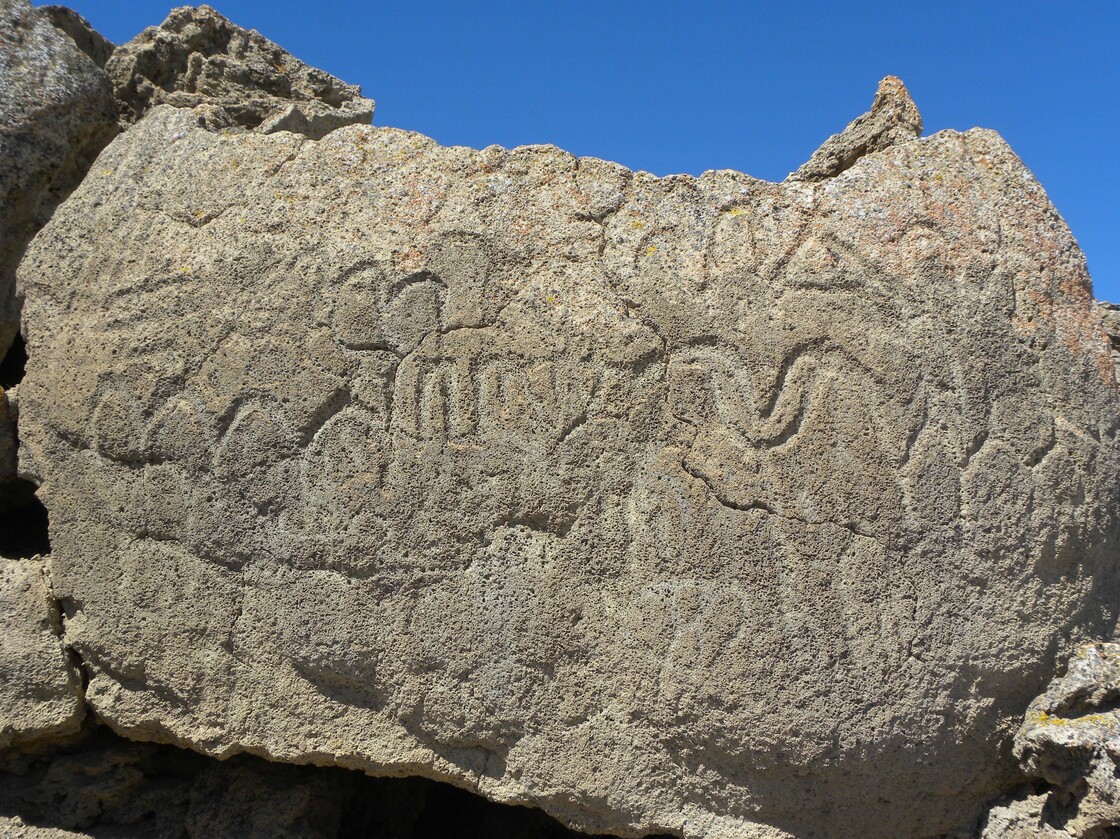
He saw a heap of big boulders. Nearly every surface covered with geometric patterns. Things like concentric circles, groups of diamond shapes and etchings that resemble trees. The collection of petroglyphs is larger than most others in the Southwest, and is carved deeper into the rock.
"They're almost unique in the sense that the grooves have been carved down almost an inch deep in some cases," says Benson, an emeritus scientist with the U.S. Geological Survey who does research for the University of Colorado and its Museum of Natural History.
Just by looking at the designs, Benson thought he might know how old they were. He noticed that the symbols are much whiter than the gray rock they're carved into.
He knew from his climate research that the dry area where the petroglyphs are located was once a lake, and that the white coating was probably left from the last time the rocks were submerged in water, which suggested that the petroglyphs may be older than 11,000 years
"And I did know, at least from my limited knowledge, that these were probably older than the oldest dated petroglyphs in North America," he recalls.
But to prove it, he needed permission from the Pyramid Lake Paiute Tribe to sample the coatings on the rocks.
It took years to get that permission, and although he did sample the rocks near the petroglyphs, he has yet to sample any of the ancient rock art.
Once he dated the different coatings on the rock — the coating that the ancient people gouged into and the one that covers their artwork — he confirmed that the artwork was at least 10,000 years old and maybe 14,800 years old. The early North Americans would have created these designs during a dry period between two very wet times. Sediment cores from the lake bottom also helped him with the dating. (Along the way, he learned that the most recent wet period lasted until 10,300 years ago, and not 11,000 as experts had previously believed.)
Jenkins, the University of Oregon archaeologist, had previously discovered the oldest human remains in North America in what's known as Paisley Caves in Central Oregon. There, he found little that could be considered art in his findings from their settlement 14,000 years ago.
And Jenkins says that Benson's findings open the door for scientists to learn more about the people who lived on this continent long ago. Many other lakes in the West's Great Basin rose and fell thousands of years ago when the climate was making dramatic shifts.
He hopes that Benson's techniques for using coatings left on rocks to date petroglyphs will be replicated elsewhere to learn how long ago ancient artists were doing their work.
Subscribe to:
Posts (Atom)